The Three-Bucket Budget: The Low-Stress Alternative to Tracking Every Dollar
Stop micromanaging fifty spending categories. The three-bucket budget groups your money into fixed essentials, future goals, and one flexible spending number.
Guilt-Free Spending Allowance
Calculate your single monthly Flex Number and daily guilt-free spending limit.
Have you ever opened an Excel spreadsheet or downloaded a modern budgeting app with grand ambitions of mastering your finances? You spent three hours setting up forty distinct spending categories: Groceries, Dining Out, Coffee Shops, Household Supplies, Entertainment, Pet Care, Personal Grooming, and Hobby Gear.
For the first week, you felt like a financial genius. You logged every five dollar receipt and categorized every coffee run.
By week three, reality crashed in. You went to a grocery store and bought dish soap, a pair of socks, a loaf of bread, and a greeting card. Suddenly you faced an existential mathematical dilemma: do you split a twenty dollar receipt across four separate categories, or just throw it into Groceries and feel guilty about inaccurate records?
Two weeks later, life got busy. You fell behind on logging transactions. Your app showed red warning alerts, and you felt completely overwhelmed. You closed the app, abandoned the spreadsheet, and returned to winging it.
This experience is shockingly common. Traditional line item budgeting fails because it demands unreasonable cognitive energy. Humans are not accounting software. We do not need fifty arbitrary buckets to manage our lives successfully.
What we actually need is simplicity. Enter the three bucket budget.
What Is the Three-Bucket Budget?
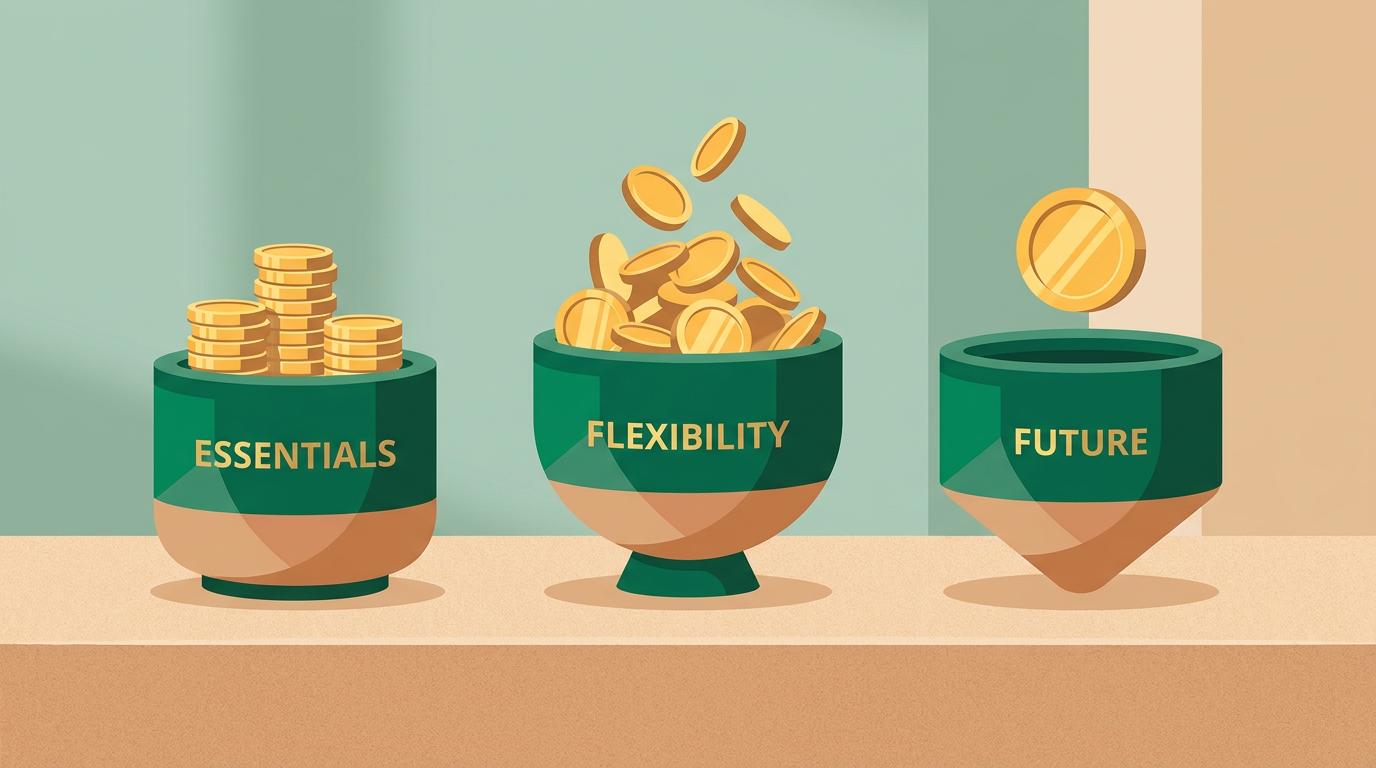
The three bucket budget, often called flex budgeting, replaces microscopic category tracking with three broad, intuitive pools of money:
- Fixed Essentials: Non negotiable monthly bills that keep a roof over your head and food on the table.
- Future Goals: Money reserved for emergency savings, debt reduction, and retirement investing.
- Flexible Spending: A single pool of discretionary cash for day to day life, guilt free.
Instead of tracking whether you spent thirty dollars on sushi or thirty dollars on a bookstore run, you only care about one single metric: your total flexible spending balance for the month.
As long as your fixed bills are covered and your future savings are funded, how you divide your flexible money is entirely up to you.
| Budget Component | Traditional 40-Category Budget | Three-Bucket Flex Budget |
|---|---|---|
| Setup Complexity | Extremely high, requires dozens of rules | Takes ten minutes on a single sheet of paper |
| Receipt Tracking | Must categorize every line item on every bill | Zero receipt splitting required |
| Mental Energy | Constant daily guilt and cognitive fatigue | Check one account balance once a week |
| Adherence Rate | Less than 20% stick with it after three months | Over 85% maintain it year after year |
Bucket 1: Fixed Essentials (The Baseline)
Your fixed bucket represents your monthly survival obligations. These are recurring payments that you are legally or contractually committed to paying:
- Rent or mortgage payments
- Basic utilities (electricity, water, heating, internet)
- Car payments and auto insurance
- Health and life insurance premiums
- Cell phone plan
- Minimum debt payments
- Baseline grocery staples
Because these costs rarely change dramatically from month to month, they are simple to total up. Calculate your fixed sum and automate it completely.
Once your fixed expenses are automated from a primary bills account, you never have to think about whether rent is paid. It happens seamlessly in the background.
Bucket 2: Future Goals (Pay Yourself First)
Before you touch a single dollar for discretionary spending, you fund your future self.
Most people make the mistake of budgeting backwards. They pay their fixed bills, spend whatever they want on dining and shopping, and plan to save whatever happens to be left over on the thirty first of the month. Inevitably, nothing is left over.
The three bucket system flips this script. Your future bucket gets funded the exact day your paycheck arrives:
- Short-Term Safety: Building or maintaining a three to six month emergency fund in a high yield savings account.
- Medium-Term Sinking Funds: Setting aside cash for planned annual expenses like car maintenance, veterinary checkups, or holiday travel.
- Long-Term Wealth: Automating contributions to a workplace retirement plan, IRA, or broad market index funds.
Whether you can afford to save ten percent, twenty percent, or five percent of your income, make this deposit automatic on payday. Once that money leaves your checking account, it is off the table.
Bucket 3: Flexible Spending (Your Single Flex Number)
Now comes the liberating part of the system.
Take your total monthly take home income. Subtract your Fixed Essentials. Then subtract your Future Goals.
The remaining balance is your Flex Number.
$$\text{Monthly Income} - (\text{Fixed Bills} + \text{Future Savings}) = \textbf{Flex Number}$$
Suppose your household monthly take home pay is $4,500:
- Fixed Essentials: $2,400
- Future Goals & Savings: $700
- Remaining Flex Number: $1,400 per month
That $1,400 is your total flexible spending allowance. Divide it by four weeks: you have exactly $350 each week for groceries, coffee runs, dinners with friends, movie tickets, new clothes, or weekend road trips.
The Beauty of Zero Micromanagement
Under this framework, you do not need separate lines for dining out, movies, and hobbies.
If you want to spend $200 of your weekly allowance on a fancy steak dinner with your partner, go right ahead. You just eat simple home cooked pasta for the rest of the week to stay under your $350 weekly cap.
If you decide to skip dining out entirely and spend your flex money on new gardening tools, nobody is judging you. You broke zero rules. Your rent is already paid. Your retirement account is already invested. You are spending your money on what brings you genuine joy without an ounce of guilt.
How to Set Up the Three-Bucket System in Your Bank
You can make this system virtually foolproof by using three separate bank accounts:
Account A: The Fixed Bills Hub
Your primary checking account where paychecks land. Automatic transfers draft fixed bills and loan payments from this account.
Account B: The High-Yield Savings Vault
A separate online savings account holding your emergency fund and future goal sinking funds.
Account C: The Flex Debit Card
A secondary checking account with its own debit card. Every Friday morning, an automated transfer sends one fourth of your monthly Flex Number into this account.
This is the only debit card you keep in your wallet. When you tap your card at a restaurant or grocery counter, you only pull from Account C. If the balance reaches twenty dollars on a Thursday afternoon, you know it is time to cook dinner at home until your Friday transfer reloads your card.
Adjusting Your Buckets When Life Changes
The beauty of the three bucket budget is that it grows with you.
When you get a raise at work, you do not need to reprogram forty categories. Simply allocate a portion of that raise toward Bucket 2 (increasing your retirement investments) and allocate the rest toward Bucket 3 (giving yourself a slightly higher weekly spending allowance).
If times get tough or inflation pushes your grocery bills higher, you can temporarily squeeze Bucket 3 while keeping Bucket 1 safe.
Escape the Budgeting Burnout Today
Managing your personal finances should give you confidence, not make you feel like an exhausted bookkeeper.
Stop drowning in micro categories and receipts that make you feel guilty for enjoying a morning latte. Group your money into three clean buckets, protect your future, and enjoy the true freedom of knowing exactly what you can spend today.
Written by EasyBudget Team
Fact-Checked • 2026 EditionOur editorial team develops free, privacy-first personal finance calculators and independent money management guides. We cross-reference all math against federal savings guidelines and macroeconomic benchmarks.